

CS2 Odds Explained
Updated
In a standard Counter-Strike 2 weapon case, the published chance of unboxing a Rare Special Item—a knife or a pair of gloves—is rounded to 0.256%. Working from the exact underlying ratios behind that table puts the true gold rate at 1 in 391. Roughly four out of every five openings land on a blue Mil-Spec skin, while Covert reds sit near 1 in 156.
Standard weapon cases and the Dead Hand Terminal follow that familiar five-tier split, but most other CS2 containers do not. Souvenir packages, sticker and autograph capsules, collectible pins, Armory collections, and the Genesis Terminal each have their own published probability tables, and knowing which table applies to which container makes the numbers a lot easier to read.
CS2 Case Odds and Knife/Glove Odds
Every standard weapon case in CS2 runs on the same five-tier probability structure. A discontinued case selling for forty dollars on the Steam Market uses the exact same tier odds as an active-drop case that costs a few cents—case price never changes the probability of hitting gold. The Dead Hand Terminal also shares these exact percentages on a per-revealed-item basis.
| Rarity Tier | Exact Ratio Weight | Official Published Chance | Derived Odds (Approx.) |
|---|---|---|---|
| Mil-Spec Grade (Blue) | 625 / 782 | 79.923% | 1 in 1.25 |
| Restricted (Purple) | 125 / 782 | 15.985% | 1 in 6.26 |
| Classified (Pink) | 25 / 782 | 3.197% | 1 in 31.28 |
| Covert (Red) | 5 / 782 | 0.639% | 1 in 156.4 |
| Rare Special Item (Gold) | 2 / 782 | 0.256% | 1 in 391 |
Each grade from Mil-Spec up to Covert is five times rarer than the one below it, and the gold slot drops at two-fifths the rate of a Covert (a 2:5 ratio). Combining those ratios across all five tiers puts a knife or pair of gloves at 2/782, which simplifies to 1/391 (0.255754%).
That also explains why you still see "1 in 385" floating around CS2 discussions. That number comes from rounding 0.255754% up to 0.26% first and dividing 100 by 0.26 (384.6). Starting from rounded percentages throws off follow-up math, so every derived figure on this page is calculated from the exact ratios instead of the three-decimal published table numbers. That same rounding is why a few official tables add up to 99.999% or 100.001% rather than a flat 100.000%.
When it comes to the gold slot itself, two details matter in practice. First, a case never pulls from every knife or glove in the game—its gold pool contains only the specific knives or gloves tied to that container, which you can check container by container on the CS2 cases list. Second, 1 in 391 is the chance of reaching the Rare Special Item tier as a whole. The official disclosure does not publish internal drop weights for individual knife finishes or Doppler phases like Rubies, Sapphires, or Emeralds, so those phase-specific odds are not established by the standard table.
The Official Source Behind CS2 Drop Rates
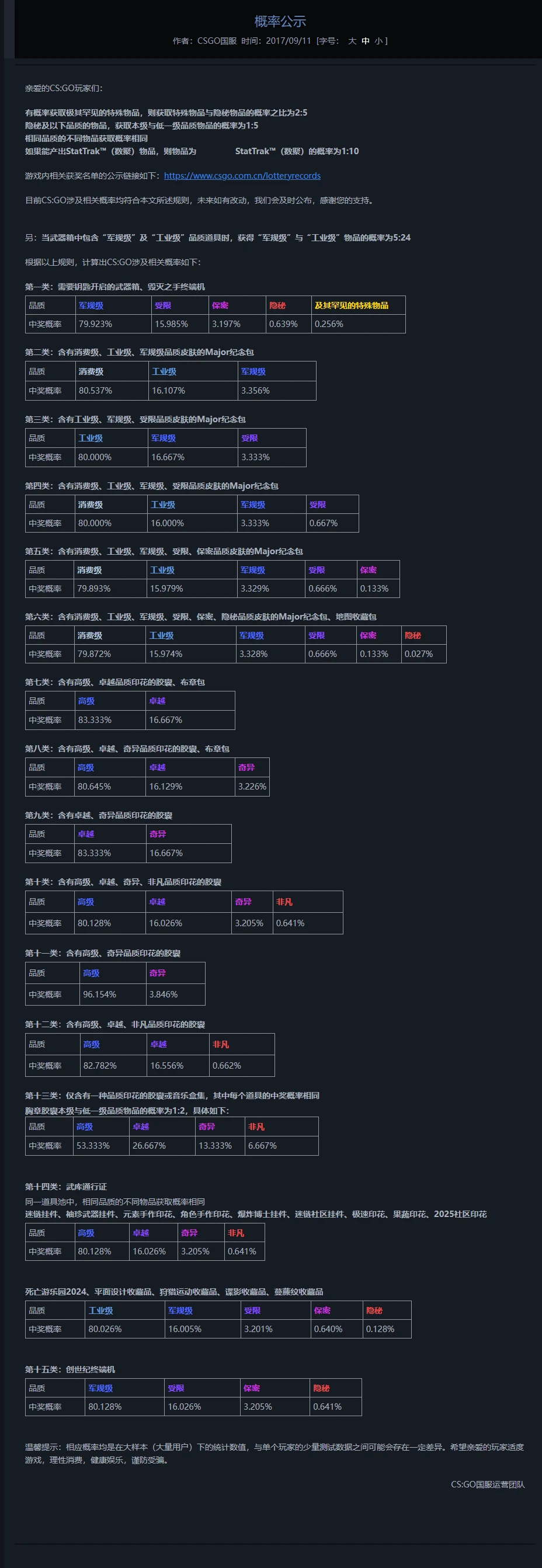
The official percentages in this guide come from the Chinese Counter-Strike probability disclosure operated by Perfect World, Valve's publishing partner in China. The page header displays 11 September 2017, while the current body includes later additions such as the Armory, Genesis Terminal, and Dead Hand Terminal across 15 numbered container groups. We checked the live version of the page on 21 November 2026.
Alongside the 15 percentage tables, the disclosure sets out four core rules that govern how CS2 container probabilities work:
- 2:5 gold-to-Covert ratio: In standard five-tier weapon containers with a Rare Special Item slot, gold drops at two-fifths the rate of Covert skins.
- 1:5 step between adjacent grades: Most multi-tier containers make each step up five times rarer than the grade below it. Where a container uses a different progression—such as the 5:24 Mil-Spec-to-Industrial ratio in Souvenir and map packages, the 1:2 progression in Collectible Pins, or the five-tier Armory weapon pool—the disclosure provides its own explicit table.
- Equal weighting inside a tier: Items that share the same rarity tier within the same container pool are equally likely once the container lands on that tier.
- 10% StatTrak chance where eligible: Whenever an item can drop in StatTrak, 10% of its drops are StatTrak and 90% are Normal. This roll does not apply to gloves or Souvenir skins.
How Individual Skin, Normal, and StatTrak Odds Work
Tier tables tell you how often you will see a purple or a pink, but most players want to know the odds of pulling one specific skin—often in StatTrak. Getting from a tier percentage to an individual finish is straightforward: take the exact probability of the skin's rarity tier and divide it by how many items sit in that tier inside the container. If you want to turn any percentage P into "1 in N" odds, divide 100 by P.
Wear conditions do not split the pool into extra equal items during that step. Whether a skin can drop in all five exteriors or only three, the game selects the skin finish from the tier pool first, while wear value and pattern seed are handled separately.
The AK-47 | Slate from the Snakebite Case is a clean way to see the math in action. The Snakebite Case has five Restricted (purple) skins. Dividing the Restricted tier's exact weight of 125/782 (15.984655%) by five gives the AK-47 | Slate a combined probability of 25/782, or 3.196931% (about 1 in 31.28). From there, the 10% StatTrak rule splits that combined figure into Normal and StatTrak editions.
| AK-47 | Slate Edition (Derived) | Exact Calculation | Derived Chance | Approx. Odds |
|---|---|---|---|
| Combined (Normal + StatTrak) | (125 / 782) / 5 | 3.197% | 1 in 31.28 |
| Normal (Non-StatTrak) | Combined × 0.90 | 2.877% | 1 in 34.76 (about 1 in 35) |
| StatTrak | Combined × 0.10 | 0.320% | 1 in 312.8 (about 1 in 313) |
A common mistake here is taking 10% of the Normal row to estimate StatTrak odds. StatTrak is 10% of all AK-47 | Slate drops, leaving Normal at 90%. That creates a 9:1 ratio between Normal and StatTrak, which is why the gap lands around 1 in 35 versus 1 in 313 instead of 1 in 35 versus 1 in 350. All wear exteriors and pattern seeds are included in those figures.
Applying that same 10% StatTrak rule to a knife-eligible weapon case puts the derived chance of unboxing any StatTrak knife at 1 in 3,910 (0.025575%). That figure applies only to cases whose gold slot drops knives—gloves never roll StatTrak—and it covers every StatTrak knife finish in that case combined rather than one specific model or finish.
Exact floats and pattern seeds are where the official numbers stop. Float ranges do not work as flat percentages across the 0.00 to 1.00 scale, so a 0.00–0.07 Factory New window does not automatically mean 7% of drops come out Factory New. Every weapon finish has its own minimum and maximum float caps, which makes some exteriors rarer or completely impossible on certain skins, and the official disclosure does not publish a universal wear or pattern-seed split. Working out the odds for a specific float tier or pattern template requires knowing that finish's actual distribution.
Souvenir Packages and Map Collection Packages
Map-based packages—groups 2 through 6 in the official disclosure—look very different from standard weapon cases. They usually start down at Consumer Grade (white) or Industrial Grade (light blue) and climb up to whatever the highest rarity in that map collection happens to be. You can browse the individual pools in the Souvenir packages directory or check our CS2 Souvenirs guide for how tournament drops fit together.
| Tiers Present in Package | Consumer | Industrial | Mil-Spec | Restricted | Classified | Covert |
|---|---|---|---|---|---|---|
| Consumer to Mil-Spec (3 tiers) | 80.537% | 16.107% | 3.356% | — | — | — |
| Industrial to Restricted (3 tiers) | — | 80.000% | 16.667% | 3.333% | — | — |
| Consumer to Restricted (4 tiers) | 80.000% | 16.000% | 3.333% | 0.667% | — | — |
| Consumer to Classified (5 tiers) | 79.893% | 15.979% | 3.329% | 0.666% | 0.133% | — |
| Consumer to Covert (6 tiers) | 79.872% | 15.974% | 3.328% | 0.666% | 0.133% | 0.027% |
Unlike weapon cases, these map and Souvenir tables use a 5:24 ratio between Mil-Spec and Industrial Grade, while every other tier step stays at the usual 1:5. In a full six-tier package running from Consumer through Covert, every extra grade adds another steep jump before you can reach the top tier.
That six-tier math is why Covert map skins are famously hard to unbox. The Covert tier sits at 5 / 18,780, which reduces cleanly to 1 in 3,756 (0.026624%)—almost ten times rarer than pulling a knife from a standard weapon case. Inverting the rounded 0.027% from the table gives a slightly off 1 in 3,704, so 1 in 3,756 is the exact figure to use. If a package has only one Covert skin in its collection, that single skin carries the full 1-in-3,756 rate; if there is more than one Covert in the pool, divide that tier rate by the number of Coverts.
A couple of practical details are easy to miss when looking at map packages. Group 6 also includes non-Souvenir map collection packages—the Anubis Collection Package, for instance, uses this six-tier table even though its drops are normal skins rather than Souvenirs. Different generations of the same map collection can also span different rarities, so it pays to check the exact collection generation rather than going by map name alone. Finally, Souvenir Packages never contain a knife or glove slot, and newer packages featuring highlight charms do not add an extra knife-tier rarity to the table.
Sticker and Autograph Capsule Odds
Groups 7 through 12 in the official notice cover sticker capsules and autograph capsules. The key thing to understand here is that capsule odds follow the four rarity grades—High Grade, Remarkable, Exotic, and Extraordinary—rather than fixed visual finish labels. Valve has moved Holo, Glitter, and Foil finishes between different rarity tiers across tournaments and capsule lines, so checking a sticker's actual rarity grade inside its capsule is what tells you its real drop rate.
| Tiers Present in Capsule | High Grade | Remarkable | Exotic | Extraordinary |
|---|---|---|---|---|
| High Grade + Remarkable (2 tiers) | 83.333% | 16.667% | — | — |
| High Grade + Remarkable + Exotic (3 tiers) | 80.645% | 16.129% | 3.226% | — |
| Remarkable + Exotic (2 tiers) | — | 83.333% | 16.667% | — |
| All 4 Rarity Tiers | 80.128% | 16.026% | 3.205% | 0.641% |
| High Grade + Exotic (Skipped Tier) | 96.154% | — | 3.846% | — |
| High Grade + Remarkable + Extraordinary (Skipped Tier) | 82.782% | 16.556% | — | 0.662% |
Notice what happens when a capsule skips a rarity tier: the remaining grades keep their original spacing instead of collapsing into a 5:1 step. In a High Grade + Exotic capsule with no Remarkable stickers, High Grade stays 25 times more likely than Exotic (25:1, or 96.154% against 3.846%). The same pattern holds when Exotic is absent from a High Grade + Remarkable + Extraordinary capsule, leaving weights of 125:25:1 and an Extraordinary tier rate of 0.662%.
Extraordinary (Gold) stickers are also much more common at the tier level than weapon-case knives, even though both show up as gold. In a four-tier capsule, hitting any Gold sticker is 1 in 156 (0.641%)—roughly two and a half times more frequent than a 1-in-391 weapon-case gold. What makes pulling one specific player or team Gold difficult is the size of the capsule's Gold pool. As an example, if a four-tier capsule holds 8 Gold stickers, the derived chance for one specific Gold is (1 / 156) / 8 = 1 in 1,248 (0.080128%). Because capsules vary in how many Golds they hold, divide 1/156 by the actual Gold count in the capsule you are opening. In single-rarity capsules where every sticker shares one grade, each sticker simply has an equal 1/N chance.
Pins, Patches, Graffiti, and Music Kits
CS2's smaller cosmetic containers each have their own quirks. Collectible pins and music kit boxes sit in group 13 with dedicated rules, patch packs share the two-tier and three-tier capsule tables, and graffiti boxes are modeled from the standard rarity progression.
Collectible Pins
Collectible Pin Capsules (group 13) step away from the usual 1:5 curve and use a much gentler 1:2 ratio between adjacent grades (exact weights 8:4:2:1 out of 15). That puts Extraordinary pins at 6.667%—far higher than Extraordinary stickers or weapon-case golds. Even so, pins in a capsule are not all equally likely; to find the odds for one particular pin, divide its tier chance below by the number of pins in that tier.
| Pin Rarity Tier | Exact Ratio Weight | Official Published Chance |
|---|---|---|
| High Grade | 8 / 15 | 53.333% |
| Remarkable | 4 / 15 | 26.667% |
| Exotic | 2 / 15 | 13.333% |
| Extraordinary | 1 / 15 | 6.667% |
Patch Packs
Patch Packs are explicitly included in the official two-tier and three-tier capsule tables. As with stickers and pins, a specific patch's odds come from dividing the tier percentage by how many patches sit in that tier.
| Patch Pack Structure | High Grade | Remarkable | Exotic |
|---|---|---|---|
| 2-Tier Patch Pack | 83.333% | 16.667% | — |
| 3-Tier Patch Pack | 80.645% | 16.129% | 3.226% |
Music Kit Boxes
Single-rarity Music Kit Boxes are also part of group 13, and their math is completely flat: every kit in the box has an equal 1/N chance. A 10-kit container like the Deluge Music Kit Box gives every individual kit a straight 10% drop rate.
StatTrak Music Kit Boxes do not work like weapon cases, where you roll a 10% chance for StatTrak on top of a normal drop. Instead, StatTrak boxes are sold separately and contain only StatTrak music kits. For example, the StatTrak Deluge Music Kit Box listing on Steam lists 10 named StatTrak kits inside, meaning every specific StatTrak kit carries a guaranteed StatTrak drop at a flat 10% chance.
Graffiti Boxes (Modeled Example)
Graffiti Boxes do not have their own published table in the official disclosure, so the numbers below are modeled estimates rather than official graffiti odds. All three boxes (the CS:GO Graffiti Box, Community Graffiti Box 1, and Perfect World Graffiti Box) contain 18 designs: 9 High Grade, 6 Remarkable, and 3 Exotic. Applying CS2's standard 1:5 step between rarity tiers to that lineup gives the modeled drop rates below.
| Rarity Tier (Modeled) | Designs in Box | Modeled Tier Chance | Modeled Chance per Specific Design |
|---|---|---|---|
| High Grade | 9 | 80.645% | 8.961% |
| Remarkable | 6 | 16.129% | 2.688% |
| Exotic | 3 | 3.226% | 1.075% |
Armory Collection and Charm Odds
Group 14 of the official disclosure covers Armory random redemptions across two distinct structures: a five-tier table for Armory weapon collections and a four-tier table for Armory charm and sticker pools.
Armory Weapon Collections
The official five-tier Armory weapon table applies to the collections listed in the disclosure: Overpass 2024, Graphic Design, Sport & Field, Spy, and Arabesque. Unlike older map collections, these follow a clean 1:5 ratio across all five grades—exact weights of 625:125:25:5:1 out of 781—putting the Covert tier at 1 in 781 (0.128%). That puts an Armory Covert halfway in feel between a regular weapon case Covert (1 in 156) and a six-tier Souvenir Covert (1 in 3,756).
| Armory Weapon Tier | Exact Ratio Weight | Official Published Chance | Derived Odds (Approx.) |
|---|---|---|---|
| Industrial Grade | 625 / 781 | 80.026% | 1 in 1.25 |
| Mil-Spec Grade | 125 / 781 | 16.005% | 1 in 6.25 |
| Restricted | 25 / 781 | 3.201% | 1 in 31.24 |
| Classified | 5 / 781 | 0.640% | 1 in 156.2 |
| Covert | 1 / 781 | 0.128% | 1 in 781 |
Each percentage above is the tier rate, not the chance for every individual skin inside that tier—if a tier holds multiple finishes, divide the tier probability by that count. Limited-edition Armory redemptions for a single named skin work differently: because the skin's identity is fixed upfront, rolling a random wear value or pattern seed on that redemption is not another case-style rarity roll. If future Armory collections are added later, their odds depend on the rarity structure published for those collections.
Armory Charm and Sticker Pools
Random Armory charm and sticker pools—including Small Arms, Missing Link, Elemental Craft, and Character Craft—use the standard four-tier 1:5 split (125:25:5:1, or 156 total parts), giving Extraordinary drops a 1-in-156 tier chance.
| Armory Charm & Sticker Tier | Exact Ratio Weight | Official Published Chance |
|---|---|---|
| High Grade | 125 / 156 | 80.128% |
| Remarkable | 25 / 156 | 16.026% |
| Exotic | 5 / 156 | 3.205% |
| Extraordinary | 1 / 156 | 0.641% |
Genesis Terminal and Dead Hand Terminal Odds
CS2's Terminals appear in two separate places in the official disclosure. The Genesis Terminal sits in group 15 with four weapon tiers and no gold slot. The Dead Hand Terminal is grouped with standard weapon cases in group 1, meaning it includes the 0.256% (1 in 391 derived) gold slot for gloves. As outlined in Valve's Dead Hand announcement, the Dead Hand lineup brings 17 weapon finishes and 22 new gloves through Terminals.
| Rarity Tier | Genesis Terminal (Per Revealed Item) | Dead Hand Terminal (Per Revealed Item) |
|---|---|---|
| Mil-Spec Grade | 80.128% | 79.923% |
| Restricted | 16.026% | 15.985% |
| Classified | 3.205% | 3.197% |
| Covert | 0.641% | 0.639% |
| Rare Special Item (Gloves) | — | 0.256% (1 in 391) |
The main difference between a Terminal and a regular case is what you actually receive. A Terminal shows you an offer to buy a skin instead of dropping one straight into your inventory, so the rates above apply per revealed item rather than to a free glove roll. Because the official disclosure does not say whether multiple offers in a Terminal session are independent rolls, you cannot safely multiply these per-item numbers into an "at least one gold across five offers" figure.
Multiple Case Openings: Real Cumulative Odds
A single 1-in-391 roll is hard to picture until you look at a full opening session. When each weapon-case opening is independent and carries gold probability p, the chance of seeing at least one Rare Special Item across n openings is 1 − (1 − p)n. Plugging in the exact value p = 1/391 gives the derived session probabilities below.
| Cases Opened (n) | Chance of At Least 1 Gold (Derived) | Chance of 0 Golds (Derived) |
|---|---|---|
| 1 | 0.26% | 99.74% |
| 100 | 22.59% | 77.41% |
| 271 | 50.04% | 49.96% |
| 391 | 63.26% | 36.74% |
| 1,000 | 92.28% | 7.72% |
The number that surprises most players is 391. Even though 391 cases is the long-run average for one gold, it is nowhere near a guarantee, and a 391-case session still has a 36.74% chance of hitting zero golds. Reaching a 50/50 coin flip takes 271 cases (50.04%), and even a 1,000-case session leaves a 7.72% chance of coming up completely dry. Long cold streaks feel rough when they happen, but they are completely normal with independent odds.
Expected Value, Case Cost, and Trade-Up Contracts
Identical tier odds do not mean identical value. Two weapon cases can share the exact same 1-in-391 gold rate and still have very different expected outcomes depending on what sits inside them. To calculate expected gross value for a container, you multiply every possible item's probability by its current market price and add all outcomes together. Net expected value subtracts the cost of the case and key—or the actual redemption or offer price for Armory items and Terminals—along with any marketplace selling fees if you intend to sell the drop.
Because CS2 skin prices move constantly across finishes, wear exteriors, StatTrak editions, and market cycles, no container has a fixed return-on-investment percentage or a guaranteed return. Comparing the actual skin pools in the cases database shows how differently two cases with the same published tier table can be structured.
Trade-up contracts operate completely outside these container tables. Rather than drawing from a fixed 1-in-391 distribution, trade-up contracts calculate outcome odds directly from the collections and rarities of the input skins you submit. Trade-ups are not limited to a single 10-item format across every rarity either—a five-Covert recipe also exists—so contract probabilities always come down to the exact recipe you put in.
Questions About Luck, Pity Timers, and Weekly Drops
Is there a pity timer in CS2 cases?
There is no published pity system or bad-luck protection in CS2's container rules. Under the official probability tables, opening hundreds of Mil-Spec skins in a row does not raise the published 1-in-391 gold rate on your next weapon case.
Do account age, time of day, or near-miss animations change odds?
Nothing in the published rules links container drop rates to account age, playtime, or the time of day you open a case. Likewise, watching a gold icon stop right next to the marker on the scrolling reel is just visual presentation—it does not mean that roll was statistically closer to landing a knife or pair of gloves.
Are Weekly Care Package case drops covered by these odds?
No. Receiving a case through your Weekly Care Package pulls from a separate weekly drop pool. The official probability disclosure covers what happens inside a container once you open or redeem it, not the drop rate of receiving a specific case from the weekly pool.
Does using a case opening simulator affect real CS2 odds?
No. Running openings in the simulator does not change real CS2 drop rates or award Steam items. It simply uses the published probability tables so you can see how 1-in-391 variance plays out over dozens or hundreds of openings without spending money.